 Case study · Industrial edge AI
From lab to line: bridging the industrial AI production gap with the Brinq AI and Synaptics edge ecosystem.
Brinq AI and Synaptics have formed a strategic partnership that delivers a production-ready ecosystem for industrial, vision-based and agentic AI, solving the integration, scaling and adaptation problems that keep OEMs and Tier 1 suppliers from realizing the value of the intelligent edge.
- EDGE AI
- AGENTIC AI
- SYNAPTICS ASTRA
- MLOPS
Background
Why lab AI fails in production
Operator cost
2× operators per check today
Changeover downtime
~30m downtime per changeover
A significant disconnect exists between the promise of artificial intelligence and its successful implementation on factory floors. Building a functional prototype in a controlled lab has become increasingly accessible. Advancing that success into full-scale production remains a major hurdle that many organizations fail to overcome.
A common pattern plays out across industrial organizations. A team proves the concept with open-source tools, pre-trained models and a successful pilot. Once the conversation shifts from demonstration to deployment, complexity rises quickly. What looked manageable in the lab becomes much harder when the solution must operate across production lines, hardware environments and changing plant conditions.
Three hurdles
What breaks between the pilot and the plant.
System-integration complexity
In a lab, a model runs on one workstation and one camera. In production, a manufacturer manages a fleet of disparate cameras, sensors and processing nodes, keeping software consistent while managing each device lifecycle.
The model adaptation crisis
A static model is a liability in a dynamic factory. Add a SKU, change the color of a part or adjust line lighting, and the model has to be updated. Without a shop-floor path to adapt models, the system goes stale or needs data scientists on call.
Data silos and management complexity
Production generates vast raw data that has to become insight, visible to the operator on the floor, usable for efficiency monitoring, and integrated into inventory, OT and other enterprise systems.
Big plant or small, these hurdles find you.
Large enterprises
Often rely on major system integration efforts, which drive up cost, extend timelines and make AI deployments harder to scale quickly.
Mid-sized organizations
May have enough internal capability to start building, but not enough structure to make it scalable or maintainable, which delays time to value.
Smaller manufacturers
See the opportunity in AI but lack a clear starting point, the internal resources or the confidence to move forward.
The solution
A production-ready edge AI ecosystem.
The partnership pairs industrial-grade silicon with sophisticated software orchestration in one full-stack solution.
Hardware
The Synaptics Astra portfolio
Hardware designed by Synaptics specifically for rugged industrial environments.
- Industrial ruggedization
- Unlike consumer-grade parts, Astra silicon supports extended temperatures and needs no active cooling, which matters on dusty or harsh factory floors.
- Tiered processing nodes
- The Synaptics Astra SL1680 handles high-speed vision AI processing, collecting images and running models. The SL2610 acts as a controller and aggregator node, managing results and analytics from multiple vision inputs.
- Advanced NPU architecture
- The SL2610 carries an NPU with transformer instructions, so it can run generative and agentic AI models. That is revolutionary capability for an entry-level CPU class.
Software
The Brinq AI AcuSight platform
Brinq AI provides the software that makes the hardware usable at scale.
- Software orchestration
- A containerized architecture lets the AcuSight platform handle configuration management and software updates across a fleet of devices from one central point.
- Decentralized data aggregation
- The platform gathers data from disparate devices across the environment and gives live visualizations of factory floor performance.
- Edge AI lifecycle management
- The critical framework for model adaptation: collect data from the field, build a dataset, train an updated model and redeploy it back into production.
Democratizing AI
The operator-level workflow
Rather than relying exclusively on data scientists or outside specialists, manufacturers give trained operators a practical way to support data collection and model updates on the shop floor. Simplified workflows let a factory staff member manage the AI lifecycle, so a plant can add a new part or change a process without calling in a data science team.
Agentic AI and edge LLMs
An edge LLM that stays grounded
The partnership runs agentic AI, effectively an edge LLM, directly on Synaptics hardware. A 270-million-parameter Gemma model from Google DeepMind answers natural-language operator questions such as "How do I fix a squeaky bearing?" or "What is production doing today?"
Tool calling prevents hallucinations by constraining the model to Brinq AI real-time data APIs, so the agent gives accurate, data-driven answers.
Primary use cases
Three core pillars of modern manufacturing.
Visual inspection
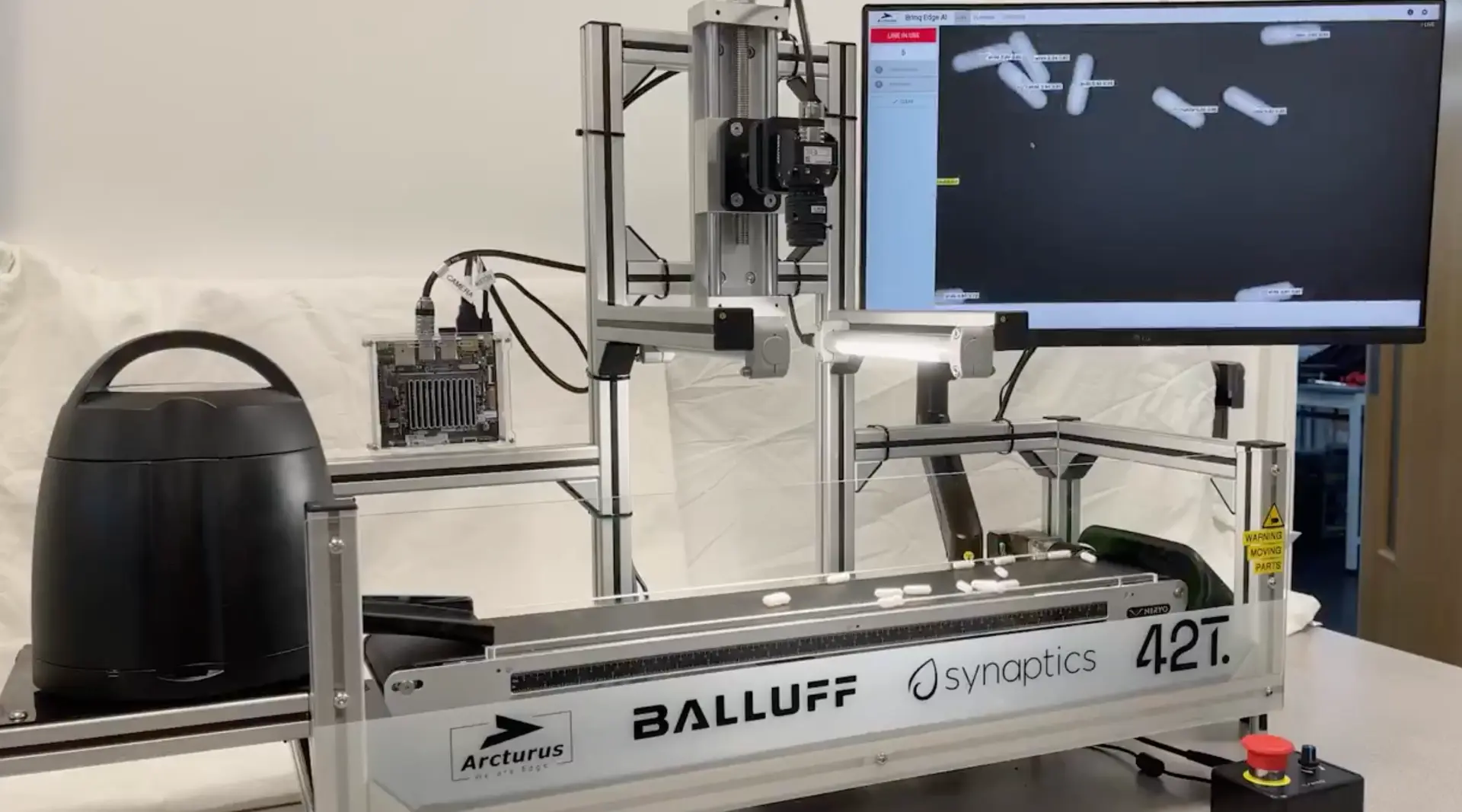
The Synaptics SL1680 drives high-speed vision AI processing, analyzing raw image feeds with high accuracy and low latency. Defects are identified in real time, so quality holds without slowing the line.
Health and safety
Continuous monitoring of the factory floor confirms operations comply with established health and safety protocols, with immediate operator alerts on potential hazards from edge-based intelligence.
Workflow supervision
Multi-step assembly processes, manual or automated, are tracked for full traceability and compliance. The system verifies quality at every stage before the final product is complete.
Quantifying the value of the edge
Business outcomes that justify the move to production.
Faster time-to-market via parallelization
Traditionally a company waits to collect enough data to train a perfect model before launching. Here you launch with a baseline model and improve it in parallel with production, collecting data and training while the rollout runs, which compresses the total project timeline.
Fractional data science and cost savings
One of the biggest hidden costs of AI is the staff needed to maintain it. This solution outsources data science complexity to the Brinq AI platform and its automated workflows, reducing expensive internal resourcing while keeping a professional team behind the models.
Data sovereignty and security
Keeping processing at the edge avoids cloud risk: zero latency for real-time equipment, privacy for proprietary manufacturing data, and full control over where data lives geographically and legally.
Low-friction evaluation
A developer can get the full stack running on Synaptics hardware with a single one-line command, and a cloud-based version of AcuSight lets prospects trial the workflow at no cost before a production deployment.
Partners
Two teams, one full stack.
Ruggedized silicon plus a software platform that democratizes model adaptation and adds agentic AI at the edge.
Brinq AI
ACUSIGHT PLATFORM, VISION AND AGENTIC MODELS, EDGE AI LIFECYCLE
Synaptics
ASTRA SL1680 AND SL2610 EDGE AI SILICON, INDUSTRIAL RUGGEDIZATION
FAQ
Questions teams ask before they deploy.
Why do industrial AI projects stall between lab and production?
Because production introduces three problems a lab never faces: fleets of disparate cameras and compute nodes that must stay consistent, models that have to be retrained every time a SKU, part color, or lighting condition changes, and raw data that has to reach operators and enterprise systems as usable insight. Solving all three in one stack is what closes the gap.
What hardware does the Brinq AI and Synaptics solution run on?
The Synaptics Astra portfolio. The SL1680 runs high-speed vision AI processing, and the SL2610 acts as a factory-floor HMI co-pilot and line supervisor. Both support extended temperatures with no active cooling, and the SL2610 NPU includes transformer instructions for generative and agentic models.
Can plant operators update AI models without a data science team?
Yes. Simplified AcuSight workflows let a trained operator collect data on the floor, build a dataset, train an updated model and redeploy it. A factory can add a new part or change a process without calling in data scientists.
How does the agentic AI avoid hallucinated answers?
A 270-million-parameter Gemma model from Google DeepMind runs on Synaptics hardware and answers operator questions in natural language. Tool calling constrains it to Brinq AI real-time data APIs, so answers come from live plant data rather than invention.
Does production data leave the plant?
No. Processing stays on-premises at the edge. That delivers zero cloud latency for real-time equipment, keeps proprietary manufacturing data under the manufacturer's control, and preserves sovereignty over where data is stored geographically and legally.
How can a team evaluate the platform before committing?
A developer can bring up the full stack on Synaptics hardware with a one-line command, and a cloud-based version of AcuSight allows a free trial of the workflow before moving to a production deployment.
Get in touch
Get started on your industrial AI use case today.
Bring us a line, a SKU mix and an inspection problem. We will show the full stack running on Synaptics hardware.