How should US manufacturers choose an edge AI platform for anomaly detection?
US manufacturers should choose an edge AI platform for anomaly detection on six criteria: inference latency on the line, whether production data stays on-premises, integration with PLCs and MES, a built-in path to retrain models as products and conditions change, freedom to use existing cameras and edge hardware, and support for delivery through a system integrator. Validate all six on your own parts and line before committing to a production deployment.
The same criteria apply to Canadian plants, where data residency and long asset lifecycles carry equal weight.
Book a Demo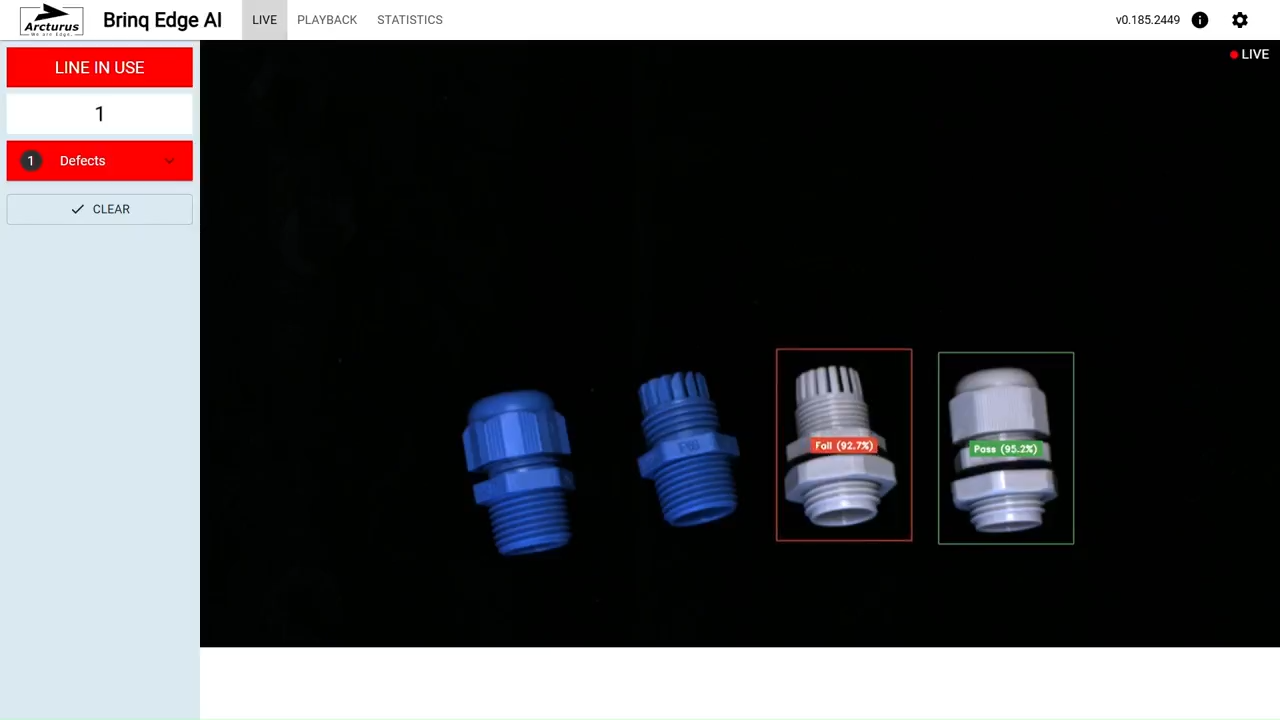
The six criteria that decide whether edge AI scales past the pilot
Proof-of-concept deployments often show strong technical feasibility, then stall when they meet real lines, sites and IT policies. The challenge is rarely building a model. It is operating edge AI as a reliable, repeatable and governable industrial system. Use these six criteria to separate platforms built for production from tools built for demos.
1. Latency on the line
Anomaly detection only works if the result reaches the line before the part moves on. That means inference runs on the edge device next to the camera, not on a round trip to the cloud, and the result does not depend on network availability.
Ask the vendor: Where does inference run? What happens to inspection when the plant network or internet link is down? Can you show results within our cycle time on our parts?
How AcuSight handles it: Inference runs on edge devices. AcuSight can be deployed fully on-premises for private operation, deterministic availability and low latency.
2. Data staying on-premises
Production images, inspection results and models are sensitive operational data. Many plants must also meet regulatory, customer or contractual requirements on where that data is stored and who can reach it.
Ask the vendor: Can the full platform run inside our facility with no cloud dependency? Is functionality reduced on-premises? Is every inspection traceable for audits?
How AcuSight handles it: AcuSight can run fully on-premises with the same capabilities as AcuSight Cloud, including onboarding workflows, data structures and management interfaces. Data stays traceable from sensor to inference to decision to system outcome.
3. PLC and MES integration
An anomaly flag has no value until it drives an action: a reject, a stop, an alert or a record. The platform must fit your automation architecture, not sit beside it.
Ask the vendor: How do results reach our PLCs, HMIs, MES and SCADA? Which industrial protocols are supported natively? Is every platform function available through an API?
How AcuSight handles it: AcuSight is API-first, with discrete APIs covering device provisioning, fleet management, data workflows and MLOps. Open APIs enable integration with PLCs, HMIs, MES, SCADA and enterprise systems such as ERP.

4. Model retraining
Drift is normal. Models degrade when real-world data diverges from training data due to seasonal variation, environmental change, equipment aging, or new SKUs, colors and materials. A platform without a retraining path turns every product change into a new project.
Ask the vendor: How is drift detected on live production data? Who curates, annotates and retrains? How are new model versions validated and rolled out, and can they be rolled back?
How AcuSight handles it: AcuSight covers the full model lifecycle: drift detection on live data, dataset curation, annotation, augmentation, training, optimization, versioning and deployment to device fleets. Guided no-code workflows suit operator-level roles, with advanced tools for expert users.
5. Hardware flexibility
Plants run cameras, sensors, SoCs, accelerators and gateways from multiple vendors and generations, and industrial systems commonly stay in service for 10 to 20 years. Locking AI to one hardware stack shortens its useful life.
Ask the vendor: Does the platform work with the cameras and edge compute we already run? Can we change hardware later without rebuilding the application? How are fleet-wide updates staged and rolled back?
How AcuSight handles it: AcuSight manages edge device fleets independent of hardware vendor or deployment topology, built on containerized software. Firmware and application updates can be staged, validated and rolled out incrementally to minimize disruption.
6. Integrator delivery
Many manufacturers buy automation through system integrators. The right platform lets your integrator deliver the complete system, without needing an in-house machine learning team and without the AI vendor competing for the account.
Ask the vendor: Can our integrator include the AI in its scope of work? Who owns model development, training and data preparation? Who supports the system after go-live?
How AcuSight handles it: BrinqAI works as the technology partner behind the integrator. BrinqAI provides the models, software and lifecycle tooling, while the integrator owns the customer relationship, hardware and system integration, and can deliver under its own brand.
Edge AI platform checklist at a glance
| Criterion | What good looks like | Red flag |
|---|---|---|
| 1. Latency on the line | Inference on the edge device, independent of network availability | Results depend on a cloud round trip |
| 2. Data on-premises | Full platform runs in your facility, with traceability per inspection | On-prem is a reduced or separate product |
| 3. PLC and MES integration | Open APIs covering every platform function | Results stuck in a standalone dashboard |
| 4. Model retraining | Drift detection, retraining and versioned rollout built in | Each product change needs a new project |
| 5. Hardware flexibility | Vendor-independent fleet management and updates | Locked to one camera or compute vendor |
| 6. Integrator delivery | Integrator scopes and delivers; AI vendor stays behind them | Vendor needs to own the end customer |
One platform for production-grade edge AI
AcuSight by BrinqAI unifies three capabilities that are usually bought and integrated separately: data ingestion and visualization across devices and sites, industrial-scale edge device management with OTA control, and continuous model adaptation with drift management. It runs fully on-premises or in AcuSight Cloud with identical capabilities. BrinqAI, based in Toronto, specializes in inspection problems traditional machine vision struggles with, including reflective or deformable materials, mixed SKUs, multi-camera environments and changing operating conditions.
Start with your parts, not a slide deck. BrinqAI validates viability on representative samples or images first, evaluating the imaging approach, data requirements, model performance and key technical risks before a production system is scoped.
Explore the AcuSight platform · Explore manufacturing solutions · Edge Vision AI vs Cloud: What Regulated Manufacturers Need to Know
Test the checklist on your own line.
Bring a difficult anomaly detection application. We will show you where edge AI fits and where it does not.
System integrator? See how BrinqAI partners with integrators →
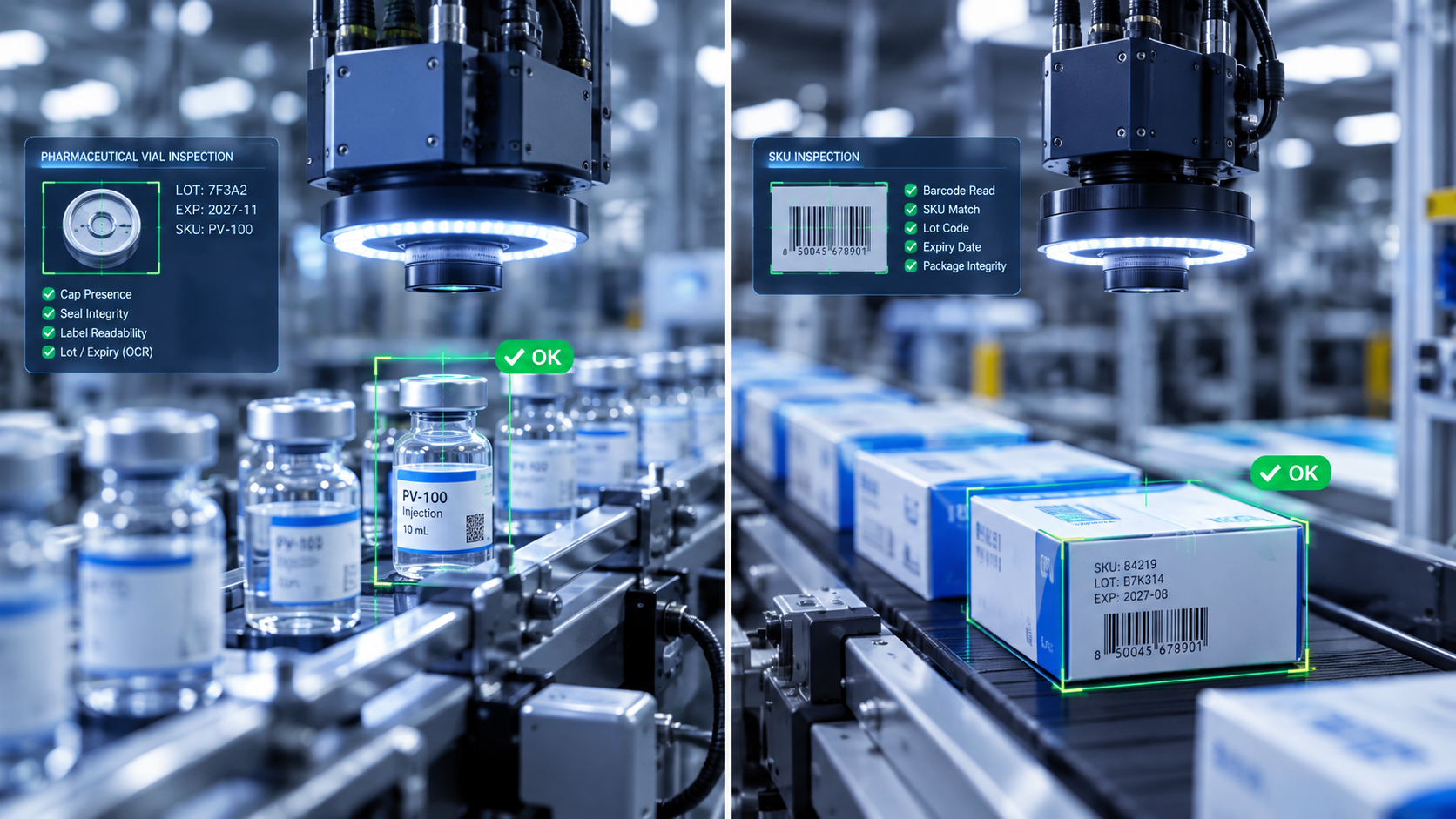
The Complete Guide to Industrial Vision AI in 2026
A practical field guide for manufacturers and systems integrators — complex inspection, reducing downtime, deployment, lifecycle management, and the 2026 provider landscape.
Fleet management with Vision AI: Synaptics SL1680
David Steele demonstrates AcuSight running on the Synaptics SL1680 at Embedded World — industrial inspections such as verifying correct gland assembly, with pass/fail assessments on the spot.
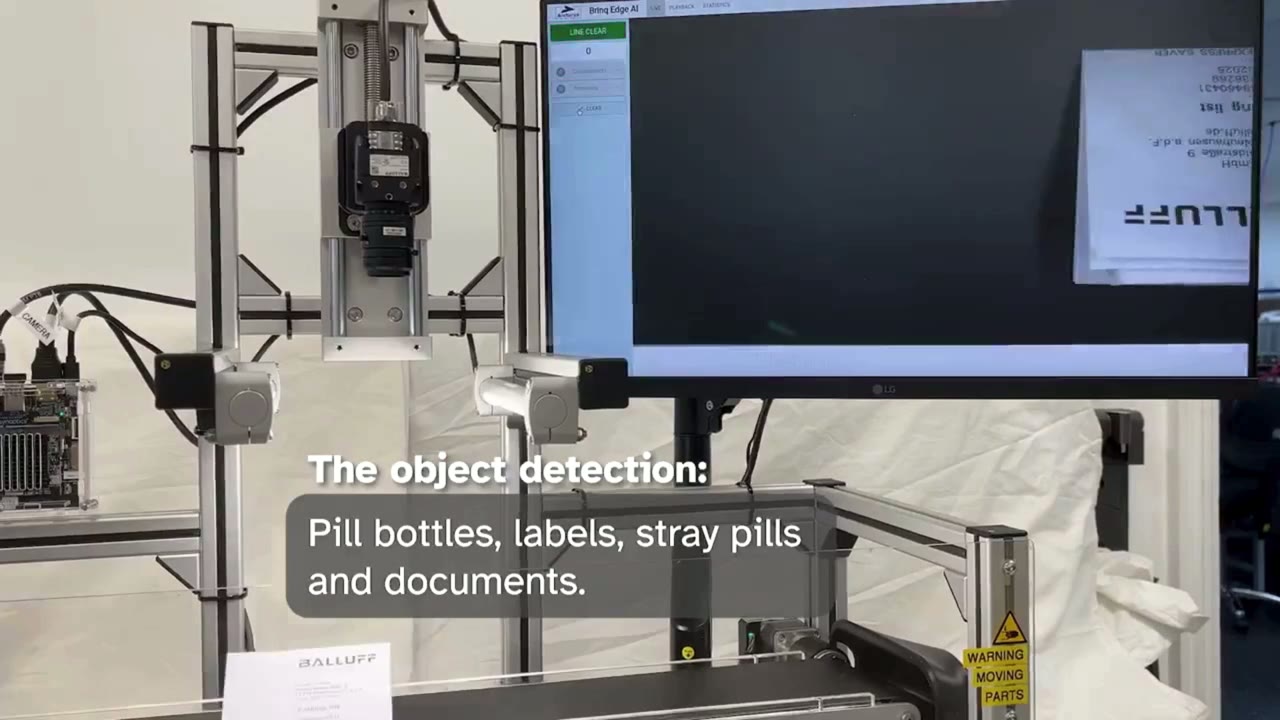
Automated line clearance for pharmaceutical production — with partner 42T
A produced case study, made with our partner 42T, on the highest-friction event on a regulated pharma floor — turning existing line cameras into a real-time inspector that catches stray objects between batches.